https://doi.org/10.35845/kmuj.2025.23321 ORIGINAL ARTICLE
Development and psychometric validation of an indigenous Urdu Histrionic personality disorder scale for adults
Samia
Rashid  1, 2, Zaqia
Bano 2 , 3
1, 2, Zaqia
Bano 2 , 3
|
1: Department of Psychology, University of Gujrat, Gujrat, Pakistan 2: Department of Psychology, National University of Medical Sciences, Rawalpindi, Pakistan 3: Department of Clinical Psychology, NUR International University, Lahore, Pakistan
Email Contact #: +92- 347-6681017
Date Submitted: February 07, 2023 Date Revised: February 18, 2024 Date Accepted: March 09, 2024 |

|
THIS ARTICLE MAY BE CITED AS: Rashid S, Bano Z. Development and psychometric validation of an indigenous Urdu Histrionic personality disorder scale for Adults. Khyber Med Univ J 2025;17(Suppl 1):S46-S53. https://doi.org/10.35845/kmuj.2025.23321 |
ABSTRACT
Objective: To develop and validate an indigenous Urdu scale for measuring Histrionic Personality Disorder (HPD) in adults, based on the diagnostic criteria outlined in DSM-5, and to assess its psychometric properties.
Methods: This cross-sectional analytical study, conducted from February 15 to June 20, 2019, was divided into two phases: scale development and verification of psychometric properties. In the development phase, a 59-item pool based on DSM diagnostic criteria was content-validated by experts and administered to 104 participants. Inter-item correlation analysis reduced the items to 41 with correlation ≥0.4. For final administration, responses from 234 adults (Males=124, Females=110) from clinical and non-clinical populations in Gujrat, Pakistan, were collected using the refined scale. Further analysis reduced the scale to 22 items, resulting in a concise measure.
Results: The initial 59-item Histrionic Personality Disorder Scale (HPDS) was refined to 22 items through Exploratory Factor Analyses (EFA) and Confirmatory Factor Analysis (CFA). EFA identified eight factors explaining 66.12% variance, while CFA confirmed seven factors with acceptable model fit indices (CFI=.941, GFI=.886, RMSEA=.056). The scale demonstrated excellent reliability (Cronbach’s α=.924) and subscale reliability ranging from .726 to .845. Convergent validity, assessed against the Brief Histrionic Personality Scale, showed a strong correlation (r=.741, p<.01). These findings establish HPDS as a psychometrically sound tool for measuring histrionic personality traits in clinical and non-clinical populations.
Conclusion: This study developed a 22-item Urdu HPDS for adults in Pakistan, demonstrating strong reliability, validity, and cultural relevance. It is a valuable tool for research, diagnosis, and clinical application across diverse settings.
Key words: Histrionic Personality Disorder (MeSH); Attention seeking behavior (Non-MeSH); Behavior (MeSH); Histrionic personality assessment (Non-MeSH), Scale development (Non-MeSH); Reliability (Non-MeSH); convergent validity (Non-MeSH); Personality (MeSH); Personality Disorders (MeSH).
INTRODUCTION
Self-appraisal, self-grooming and self-love are such optimizing traits. It makes a person more confident about one’s abilities and real self. But, to behave nicely that others may like and to wear attractive clothes that others may appraise only make oneself to mask one’s real identity. Attention seeking behavior is one of the major symptoms of histrionic personality disorder which obstructs in normal functioning. In order to seek other’s attention, one develops a cover over oneself and portrays what one is actually not.
Histrionic personality disorder first seems in DSM-II. The term hysteria derived from Greek word “hystera” meaning womb or uterus. It also has Egyptians, Greeks, and Romans meaning, apprehensions of the societies at each time.1 Hysterics are dramatic and passionate in their associations, explicit seductive behaviors, shifting romantic partners and each time with same affiliation, tapping back the previous affairs just like the cycle or roller coaster.2
Histrionic personality disorder is a disorder in which a person express attention seeking behavior; wants to be a center of attention and feel uneasy when they do not catch others consideration, make even romantic associations for the personal sake, rapidly change their emotion and romantic partner, physically appeals others, excessive focus on self-grooming, impressive speech and may lack details, easily trust and prejudiced to others, exaggerated emotions and intimacy even to a least known person. Five or more out of eight indicators must exist for proper identification.3 1.84% commonness calculated through National Epidemiologic Survey on Alcohol and Related Conditions 2001-2002. Its ratio estimated greater in females, but studies also identified same existence in both male and female. As compare to other personalities, histrionic personality gained not more devotion or focus and just few researches were conducted on it.4 Sperry (2013)5 provided the histrionic personality trait continuum, which contain seven elements. These seven elements break down the optimal functioning. As a person get closer or increasing symptoms of histrionic traits, may get away from optimum functioning. Both ideal and maladaptive behaviors, contradictory to each other, were explained on a continuum.
Histrionic personality disorder is multifactorial in its origin. It tends to run in families so, there is a genetic vulnerability for this disorde.6 Childhood traumatic events and endurance with their trauma in a way to cope with their environment leads to personality disorder.7 Over-indulging parenting style and parent’s seductive behavior, especially father’s seductive behavior towards his daughter, and upbringing in an environment where there are excessive dirty talks about sex are seen as a cause of histrionic personality disorder.
Prevalence estimated in general population as 0% to 5.3% and 1% to 17% estimated in clinical samples.8 According to another study its prevalence in general population is about 2 to 3%.9 A person with substance use disorder is at risk for histrionic personality disorder.10 Family history of personality disorders and childhood trauma also contributed as risk factor.11 In clinical setting, its prevalence in females is far high than males but some other studies depicted its same prevalence in males and females.12
There are very few studies and measuring instruments available on histrionic personality problems and these scales are developed and validated on western societies and cultures. Due to the lake of indigenous personality measures in Urdu language, the current research will play a crucial role for the assessment of histrionic personality disorder. The objective of the current study was to develop and validate an Indigenous Histrionic Personality Disorder Scale (HPDS) for adults in the cultural context of Pakistan, and to evaluate its psychometric properties for use in clinical and non-clinical populations.
METHODS
The current study was designed to attain the following objectives:
1. Development an indigenous scale of HPDS for Adults in national (Urdu) language of Pakistan.
2. Determination of psychometric properties for HPDS.
The study was approved by Departmental Research Review Committee (DRRC) of Department of Psychology, University of Gujrat, Pakistan for ethical concerns and was conducted from 15 February 2019 to th 20 June 2019. The study used cross-sectional analytical study design and the data was collected from different government and private colleges, universities, hospitals and communities of Gujrat, Pakistan.
Phase I: Development of an indigenous Histrionic personality disorder scale: The first phase of study based on the development of HPDS. Following steps were followed for development of HPDS for adults. Items were generated on the basis of Diagnostic and Statistical Manual of Mental Disorders- 5 diagnostic criteria of histrionic personality disorder. A pool of 59 items were generated. These items reflected the individual thoughts, behaviours and interpersonal relationships. The item pool then content validated by subject specialists. Five PhD subject experts evaluated each item with respect to its essentiality, appropriateness of material in reference to adults, construct of personality disorders. After the watchful analysis 55 items for antisocial personality disorder were finalized for tryout. Try out carried out to check the user appropriateness and understanding about the test to identify potential problem. This phase was carried out on histrionic 55 items scale. The test administered on 104 participants with the Likert rating scale i.e., absolutely not “1”, not “2”, to some extent “3”, yes “4”, and yes absolutely “5”.13
Participants: Participants for this study was a total number of 234 individuals (N=234), recruited from government and private educational and health institutes. Target population for this study was all male female adults recruited from government and private colleges and universities, communities and hospital of Gujrat city. Sample age was 18 years to onward and sample size 234 respectively.
Inclusion criteria
I. Age range of participants were between 18 years to onward.
II. Participants were recruited from both clinical and non-clinical population.
III. Participants were drafted from community, educational institutes; government and private school teachers, college and university faculty and students, and health institutes; hospitals.
IV. Both males and females were included.
V. Cultural context was considered.
Exclusion criteria
I. Below 18 years population were excluded.
II. People with Physical disability were excluded.
III. People with psychotic disorder and intellectual disability were also excluded.
Sampling technique: Purposive sampling technique was employed to recruit the participants. Purposive sampling technique is a type of non-probability sampling technique which is based on characteristics of a population and the objective of the study.
Research instruments: The instruments which were used in this study are informed consent form, demographic form and indigenous HPDS.
Correlation analysis: Correlation analysis was run on the scale and below .4 values item were discarded. Age above 18, sample of 104 were recruited form colleges, university and hospitals and 55 items scale was administered. After collecting data, inter item correlation was carried out to find out the correlation of each item with total items score. 41-items were endured with correlation of above .4, 14 low correlation items were excluded. For final administration 234 adults, comprising (Male= 124, Female= 110) clinical and non-clinical both above 18 years, were employed from schools’ teachers, colleges and university faculty, students, and hospitals as well. By considering ethical standards like consent, debriefing, dignity, data was collected form clinical and non-clinical population.
RESULTS
Exploratory factor analysis (EFA): The items with less than .4 values were suppressed. Factor loading find the relationship range between factor and item. Factor loading prescribed value is +1 to -1, the extent to which factor loading closer to +1 or -1, there will be higher association among factors. Significant cut-off value for factor loading is .32,14 but literature also supported .3 - .4.15 Total eight factors were explored by rotation component matrix. By suppressing the below .4 value items seven factors were extracted through EFA (Table I). 14-Items with <0.4 values were discarded and 41-items with >0.4 values were retained.
Table I: Correlation coefficient of 41 items of histrionic personality disorder (n=104)
|
Sr. No. |
Item No. |
R |
Sr. No. |
Item No. |
R |
|
1 |
2 |
.409** |
22 |
31 |
.657** |
|
2 |
3 |
.583** |
23 |
32 |
.594** |
|
3 |
4 |
.490** |
24 |
33 |
.720** |
|
4 |
5 |
.482** |
25 |
34 |
.478** |
|
5 |
6 |
.668** |
26 |
35 |
.653** |
|
6 |
7 |
.541** |
27 |
36 |
.541** |
|
7 |
8 |
.412** |
28 |
37 |
.564** |
|
8 |
9 |
.496** |
29 |
38 |
.527** |
|
9 |
13 |
.531** |
30 |
40 |
.511** |
|
10 |
14 |
.481** |
31 |
41 |
.516** |
|
11 |
15 |
.615** |
32 |
42 |
.633** |
|
12 |
16 |
.655** |
33 |
43 |
.615** |
|
13 |
17 |
.588** |
34 |
44 |
.494** |
|
14 |
20 |
.470** |
35 |
47 |
.414** |
|
15 |
21 |
.510** |
36 |
49 |
.556** |
|
16 |
24 |
.422** |
37 |
50 |
.428** |
|
17 |
26 |
.543** |
38 |
51 |
.541** |
|
18 |
27 |
.619** |
39 |
52 |
.696** |
|
19 |
28 |
.591** |
40 |
53 |
.565** |
|
20 |
29 |
.581** |
41 |
55 |
.546** |
|
21 |
30 |
.610** |
|
|
|
**.Correlation is significant at the 0.01 level (2-tailed)
Table II: Kaiser-Meyer-Olkin (KMO) and Bartlett’s test of sphericity (n=234)
|
Variable |
KMO |
Bartlett’s Test |
||
|
Chi-Square |
Df |
Sig |
||
|
Histrionic Personality Disorder Scale (HPDS) |
.931 |
6098.962 |
820 |
.000 |
Results indicated that Kaiser-Meyer-Olkin measure of sampling adequacy was >.93 and Bartlett’s test of sphericity was significant (p<.001) [Table II].
Table III: Factor loading of 40 item on Histrionic personality disorder
Scale after varimax rotation (n=234)
|
Sr. No. |
Item No. |
1 |
2 |
3 |
4 |
5 |
6 |
7 |
8 |
|
1 |
5 |
.661 |
|
|
|
|
|
|
|
|
2 |
8 |
.675 |
|
|
|
|
|
|
|
|
3 |
9 |
.738 |
|
|
|
|
|
|
|
|
4 |
10 |
.651 |
|
|
|
|
|
|
|
|
5 |
11 |
.746 |
|
|
|
|
|
|
|
|
6 |
12 |
.815 |
|
|
|
|
|
|
|
|
7 |
13 |
.825 |
|
|
|
|
|
|
|
|
8 |
14 |
.650 |
|
|
|
|
|
|
|
|
9 |
40 |
.594 |
|
|
|
|
|
|
|
|
10 |
41 |
.591 |
|
|
|
|
|
|
|
|
11 |
7 |
|
.621 |
|
|
|
|
|
|
|
12 |
16 |
|
.430 |
|
|
|
|
|
|
|
13 |
24 |
|
.492 |
|
|
|
|
|
|
|
14 |
25 |
|
.687 |
|
|
|
|
|
|
|
15 |
35 |
|
.593 |
|
|
|
|
|
|
|
16 |
37 |
|
.614 |
|
|
|
|
|
|
|
17 |
38 |
|
.600 |
|
|
|
|
|
|
|
18 |
30 |
|
|
.694 |
|
|
|
|
|
|
19 |
31 |
|
|
.778 |
|
|
|
|
|
|
20 |
32 |
|
|
.559 |
|
|
|
|
|
|
21 |
33 |
|
|
.506 |
|
|
|
|
|
|
22 |
39 |
|
|
.468 |
|
|
|
|
|
|
23 |
1 |
|
|
|
.634 |
|
|
|
|
|
24 |
2 |
|
|
|
.698 |
|
|
|
|
|
25 |
3 |
|
|
|
.644 |
|
|
|
|
|
26 |
4 |
|
|
|
.661 |
|
|
|
|
|
27 |
6 |
|
|
|
.431 |
|
|
|
|
|
28 |
15 |
|
|
|
|
.522 |
|
|
|
|
29 |
19 |
|
|
|
|
.521 |
|
|
|
|
30 |
20 |
|
|
|
|
.707 |
|
|
|
|
31 |
21 |
|
|
|
|
.558 |
|
|
|
|
32 |
22 |
|
|
|
|
.642 |
|
|
|
|
33 |
23 |
|
|
|
|
.620 |
|
|
|
|
34 |
26 |
|
|
|
|
|
.415 |
|
|
|
35 |
27 |
|
|
|
|
|
.724 |
|
|
|
36 |
28 |
|
|
|
|
|
.755 |
|
|
|
37 |
29 |
|
|
|
|
|
.755 |
|
|
|
38 |
17 |
|
|
|
|
|
|
.517 |
|
|
39 |
18 |
|
|
|
|
|
|
.683 |
|
|
40 |
34 |
|
|
|
|
|
|
|
.673 |
Extraction Method: Principal Component Analysis. Rotation Method: Varimax with Kaiser Normalization.Note: (Values<.4 are suppressed)
Eight factors revealed as a result of EFA, which describe 66.12% variance. Factor loading of items ranged from .43 to .82.
EFA findings depicted eight domains but Confirmatory Factor Analysis (CFA) reduced to seven to get the better model fit. All the domains have fluctuating number of question ranges from two to seven. First domain united sexual seductiveness and narrow emotion’s expressions. Second, gathered suggestibility and show off excessive intimacy. Exaggerated emotionality scattered into third and seven area. Attention seeking behaviours either bodily or sexually occupied a proper place.
a) Confirmatory factor analysis (CFA): Conformity factor analysis was conducted to confirm whether data is favourable to consequences of exploration phase or not and it was accomplished by using Amos Graphics7 (Figure 1).
There were eight factors discovered through EFA, which was further gone through CFA and seven factors were established with difference in questions quantity, escalating from two to seven. Testing questions were detected in regression weight, and that items were discarded. After one-by-one item deletion model estimates were considered until the good Comparative Fit Index (CFI) value establishment.
Table IV: Model fit summary of confirmatory factor analysis (n=234)
|
P-Value |
CMIN/DF |
GFI |
AGFI |
CFI |
RMSEA |
RMR |
|
.000 |
1.718 |
.886 |
.847 |
.941 |
.056 |
.054 |
CMIN/DF: chi-square minimum/degree of freedom; GFI: Goodness of Fit Index; CFI: Comparative Fit Index, AGFI: Adjusted Goodness of Fit Index; RMSEA: Root Mean Square of Error Approximation
The figures of confirmatory factor analysis of Histrionic Personality Scale for Adults are depicted with seven symptomatology by removing 19 items that are listed as, 1, 3, 5, 6, 12, 13, 14, 16, 21, 24, 26, 29, 33, 34, 36, 37, 39, 40 and 41 (Table IV).
According to the table IV CFI=.941, GFI=.941 and AGFI=.847 these values show appropriate model fit.
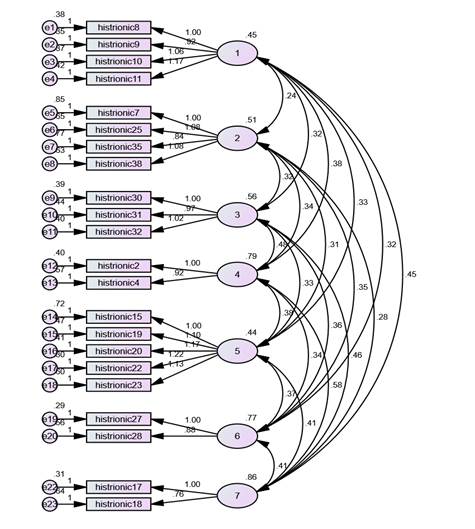
Figure 1: Confirmatory Factor Analysis of HPDS–Confirmatory factor analysis resulted in 22 item Histrionic Personality Disorder Scale for Adults.
Phase II: Determination of psychometric properties of Histrionic personality Disorder Scale
a) Cronbach’s alpha reliability: Cronbach’s alpha reliability of the urdu version of the HPDS and subscales is shown in tables V and VI respectively. The reliability of the scale presented α= .924 whereas, the appropriate reliability limit is 0.70 and above as per literature. The reliability of the HPDS is significantly high (Table V). The relisability of all the subscales that are mentioned in table VI is significantly high. Because >0.7 reliability value estimated as the significant value.
Table V: Cronbach alpha of Histrionic personality disorder scale (n=234)
|
Scale |
Cronbach’s Alpha |
Number of Items |
Sig |
|
Histrionic Personality Disorder Scale (HPDS) |
.924 |
22 |
.000 |
Table VI: Cronbach alpha of subscales of Histrionic disorder scale (n=234)
|
Subscales |
Total items |
Cronbach Alpha |
|
1. Seductive behaviour |
4 |
.834 |
|
2. Intimation |
4 |
.737 |
|
3. Exaggerated emotion |
3 |
.802 |
|
4. Feeling of uneasiness |
2 |
.750 |
|
5. Physically appealing behavior |
5 |
.845 |
|
6. Impressive speech style |
2 |
.757 |
|
7. Boastfulness |
2 |
.726 |
Note: **p <.01
b) Construct validity of Histrionic personality disorders scale: Sample of 47 (N=47) Male=29, Female=18 recruited from colleges and university faculty and students and community population. To appraise the validity of HPDS, Brief Histrionic Personality scale (BHPS) was used (Table VII).
Brief Histrionic Personality scale (BHPS) is 11-item screening measure which is designed to evaluate the attention seeking and physically appealing behaviors.4 Table VII depicted that convergent validity of the scale is .741** which is an appropriate value with respect to measure the psychometric soundness of the scale.
Table VII: Validity analysis of Histrionic personality disorder Scale (n=47)
|
Scales |
1 |
2 |
|
1. Histrionic |
- |
|
|
2. HBS |
.741** |
- |
Note: **<.01, HBS=Histrionic Brief Scale
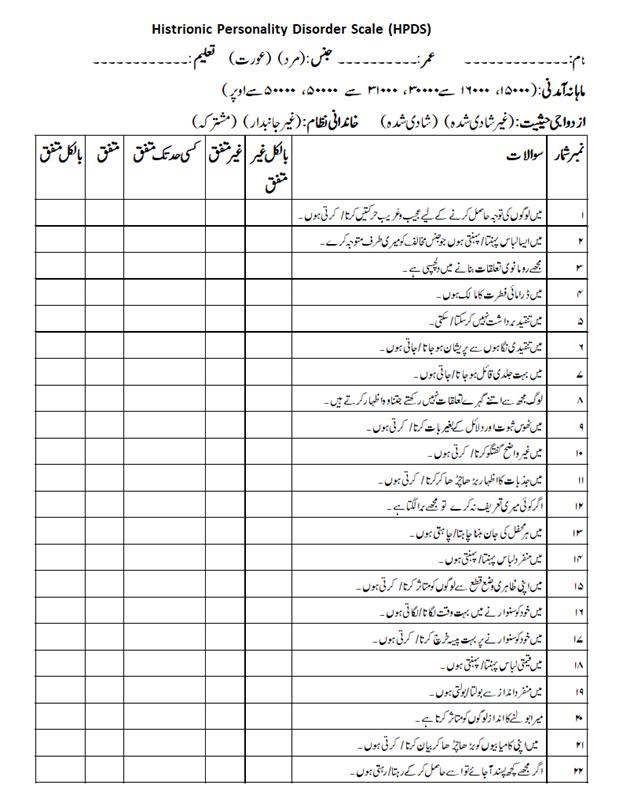
Histrionic Personality Disorder Scale (English & Urdu versions) are given as Annexures (Appendix 1 & 2).
DISCUSSION
This study developed and validated the HPDS as a reliable tool with strong psychometric properties. EFA identified eight factors explaining 66.12% variance, with item loadings from 0.43 to 0.82. CFA confirmed a good model fit (CFI = 0.941, GFI = 0.941, AGFI = 0.847). The scale demonstrated high internal consistency (Cronbach’s α = 0.924), robust subscale reliability (0.726–0.834), and significant convergent validity (r = 0.741, p < 0.01) with BHPS.
Heightened emotion is one of the grounded symptoms that better explain histrionics (APA, 2000).2 In DSM-I there was no separate category for this disorder but also its symptoms somehow explained in emotionally unstable personality. This research has two main studies to examine reliability, convergent soundness and aspect construction of a new degree for the symptom of histrionic personality disorder. As compare to other personality disorders like borderline, histrionic personality disorder has gained little consideration in research and clinical setting. There are some measures available in international language but there is no impartial clinical measure for histrionic symptoms in Pakistani language, Urdu. Current histrionic scale appears as 8 facet scale in first stage analysis, its KMO = .931, variance = 66.12%, and 40 loaded items with .43-.83 factor packing series, significant values support to advance on the next stage. One item removed in exploration phase due to having less than .4 rate. Seven dimensions detected in confirmation of factor phase containing different number of questions in each domain. One dimension was fused, explaining two symptoms in one category that is influential and exaggerated emotionality. As no covariance was drawn among items so the deletion of items based on regression weights suggestion. By omitting 18 items, deciding a precise measure with 22 items, desired values were obtained as follows: RMSEA = .05,16 CFI = .941, GFI = .886, and CMIN/DF = 1.718. The depicted figures are expression of appropriately fit model. High correlation has been estimated between HPDS and Brief Histrionic Personality scale (BHPS) (Ferguson & Negy, 2014)4 . The convergent validity of the scale was .741** and reliability was .924, both are significant values. Hence, 22-items self-report measure was constructed. These findings well supported the scale development procedure and may have implication for future research and diagnostic purpose by mental health professionals and researchers.
There are some limitations in the study which can be overcome by conducting more validation studies in order make it more psychometrically sound. Moreover, it can be translated and adapted into other languages so that it can be used internationally. In order to better use in psychiatric setting more data can be collected on clinical sample.
CONCLUSION
This study developed and validated the Histrionic Personality Disorder Scale in Urdu, native language of Pakistan for adults, adhering to rigorous psychometric methods. Based on DSM-5 criteria, the scale underwent expert validation, exploratory and confirmatory factor analysis, resulting in a 22-item tool with a strong model fit. Reliability was high and convergent validity was significant. The HPDS is a reliable and culturally relevant tool for assessing histrionic personality traits in clinical and non-clinical settings, with potential applications in research and practice. Future studies should expand its validation across diverse populations.
REFERENCES
1. Novais F, Araújo A, Godinho P. Historical roots of histrionic personality disorder. Front Psychol 2015;25(6):1463. https://doi.org/10.3389/fpsyg.2015.01463
2. American Psychiatric Association. Diagnostic and Statistical Manual of Mental Disorders. (4th ed. TR). American Psychiatric Association; Washington, DC, USA. 2000. ISBN: 978-0890420256.
3. American Psychiatric Association. Diagnostic Statistical Manual for Mental Disorders. (5th ed. TR). American Psychiatric Publications; Arlington, VA, USA. 2013. ISBN: 978-0890425763
4. Ferguson CJ, Negy C. Development of a brief screening questionnaire for histrionic personality symptoms. Pers Individ Dif 2014;66:124-7. https://doi.org/10.1016/j.paid.2014.02.029
5. Sperry L. Handbook of Diagnosis and Treatment of DSM-IV-TR Personality Disorders. 2nd ed. Bruner-Routledge; New York, USA. 2003. ISBN: 978-0415935692
6. Morrison J. Histrionic personality disorder in women with somatization disorder. Psychosomatics 1989;30(4):433-7. https://doi.org/10.1016/s0033-3182(89)72250-7
7. Cale EM, Lilienfeld SO. Histrionic personality disorder and antisocial personality disorder: sex-differentiated manifestations of psychopathy? J Pers Dis 2002;16(1):52-72. https://doi.org/10.1521/pedi.16.1.52.22557
8. Ronningstam EF. Narcissistic personality disorder: facing DSM-V. Psychiatr Ann 2009;39(3):111–21.
9. Nestadt G, Romanoski AJ, Chahal R, Merchant A, Folstein MF, Gruenberg EM, et al. An epidemiological study of histrionic personality disorder. Psychol Med 1990;20(2):413-22. https://doi.org/10.1017/s0033291700017724
10. Lilienfeld SO, Van-Valkenburg C, Larntz K, Akiskal HS. The relationship of histrionic personality disorder to antisocial personality and somatization disorders. Am J Psychiatry 1986;143(6):718-22. https://doi.org/10.1176/ajp.143.6.718
11. Arthur M. Histrionic personality disorder: description, incidence, prevalence, risk factors, causes, associated conditions, diagnosis, signs and symptoms and treatment; 2010. Accessed on: January 23, 2023. Available from URL: http://www.health.am/psy/histrionic-personality-disorder/
12. French JH, Torrico TJ, Shrestha S. Histrionic Personality Disorder. [Updated 2024 Jan 31]. In: StatPearls [Internet]. Treasure Island (FL): StatPearls Publishing; 2024. Accessed on: March 05, 2024. Available from URL: https://www.ncbi.nlm.nih.gov/books/NBK542325/
13. Tay L, Jebb A. Scale Development. In Rogelberg, S (Ed), The SAGE Encyclopaedia of Industrial and Organizational Psychology. 2nd ed. Thousand Oaks, CA: Sage; 2017.
14. Worthington RL, Whittaker TA. Scale development research: a content analysis and recommendations for best practices. Couns Psychol 2006;34(6):806-38. http://dx.doi.org/10.1177/0011000006288127
15. Miller-Carpenter S. Ten steps in scale development and reporting: a guide for researchers. Commun Methods and Meas 2018;12(1):25-44. http://dx.doi.org/10.1080/19312458.2017.1396583
16. Schumacker RE, Lomax RG. A beginner’s guide to structural equation modeling (2nd ed.). Psychology Press, USA. 2004. https://doi.org/10.4324/9781410610904
|
CONFLICT OF INTEREST Authors declared no conflict of interest, whether financial or otherwise, that could influence the integrity, objectivity, or validity of their research work. GRANT SUPPORT AND FINANCIAL DISCLOSURE Authors declared no specific grant for this research from any funding agency in the public, commercial or non-profit sectors |
|
DATA SHARING STATEMENT The data that support the findings of this study are available from the corresponding author upon reasonable request |
|
|

|
KMUJ web address: www.kmuj.kmu.edu.pk Email address: kmuj@kmu.edu.pk |
APPENDIX-01
Histrionic Personality Disorder Scale
Test Instructions
Item Scoring Format
1 = Strongly Disagree. 2 = Disagree. 3 = To some extent. 4 = Agree. 5 = Strongly Agree.
*No reverse scoring for any item.
|
Subscales |
Item No. |
Total items |
|
1. Seductive behavior |
1-4 |
4 |
|
2. Intimation |
5-8 |
4 |
|
3. Exaggerated emotion |
9-11 |
3 |
|
4. Feeling of uneasiness |
12-13 |
2 |
|
5. Physically appealing behavior |
14-18 |
5 |
|
6. Impressive speech style |
19-20 |
2 |
|
7. Boastfulness |
21-22 |
2 |
APPENDIX-02